Why do men suffer from hair loss? The answer to that question is different based on each individual.
Hi guys, Happy New Year! I am happy that you are here to continue talking about all things ‘hair’ me. As promised since forever -sigh- this blog is for the men. Hi Kings.

Going into the new year we want to keep your hair looking and feeling healthy. So this is for you, men, with one of the most common concerns ever, hair loss.
I know most men struggle with hair loss at some point in their life, some as early as their teenage years or early 20’s and others around their 50’s. Women do too, after all, hair loss or alopecia which is the medical term, affects both sexes and for different reasons; hormonal changes, medical or heredity issues or stress.
The main reason however, is heredity, due to genetics men and women may experience hair loss overtime that looks quite similar to that of their parents, whether its a receding hairline or a bald crown.

Although there is hair everywhere on our bodies except our palms and the soles of our feet, we tend to shave everywhere but our heads. It is for that reason we are quick to recognize when something is not right and hair loss begins, this is even more so for men as it is easier to identify. If you are currently having to deal with this problem, don’t worry, you are not alone, 25% of men starting losing hair before 30 and 4 out 5 men 50 years and older are balding.
This may start to occur gradually or suddenly depending on the cause. The symptoms may include;
- patching or sparse hair in a circular spots. This may occur all over the head and sometimes in the eyebrows or beards.
- sudden loosening of hair. Clumps of hair may come out in your hands, comb/brush or shower with just a light pull.
- significant changes in your hairline. It is obvious that the shape of your hairline has changed when you look in the mirror or at a picture of yourself. It has receded into a V-shape, a clear difference from the previous flat shape.
- thinning of the hair at the top of the head. Sometimes this is accompanied by a receding hairline and gives an almost definitive M-shape.
- thinning of hair on the entire scalp.
- thinning and balding of the crown. This is the most common sign of hair loss among males both young and old.
- full- body hair loss. Illnesses and medical treatments often result in this symptom.
- patches of scaling all over the scalp. Definitely an health issue, usually the sign of ringworms.
If you are experiencing any of those symptoms, the best choice is to visit the dermatologist, who will be able to identify the specific cause for your hair loss. Some men accept the balding which comes with age and rock the bald look very well. However if you’re not willing to take that route, then you need to find out what the cause is even if it’s age or genetics, so you’ll know what treatment or products will work best for you.
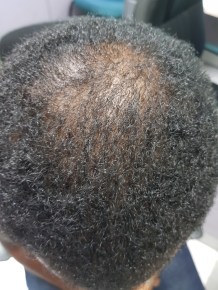
The different categories of hair loss or alopecia are;
- Androgenic alopecia or pattern baldness. This type of hair loss affects both males and females, in males it is called male pattern baldness. It is genetic and causes a receding hairline and gradual balding of the crown and the frontal area of the scalp. This can start as early as the late 20’s.
- Involutional alopecia. This is the natural, gradual thinning of hair on the entire scalp. Existing hair becomes shorter and fewer as growth is stopped and the follicles go into a resting phase.
- Alopecia areata. Small, circular patches which occur suddenly on the scalp in both adults and children. These patches are smooth and completely bald. The hair usually regrows within three to six months without treatment. This can also appear in the eyebrows.
- Traction alopecia. This is common among men who sport braids, ponytails or locs. It describes the thinning caused by these tight hairstyles.

Stevie Wonder. Credit:TheIdleMan The talented Stevie Wonder is a prime example of a male who has suffered from this type of hair loss.
- Telogen effluvium. Temporary hair thinning which occurs because of changes in the hair growth cycle. Typically, hair lives for three years and then rest, loosens and falls out. This stage of resting is called telogen, it typically lasts for three months after which the body replaces the lost hair. When some form of stress or shock affects the body, this process is interrupted and then the effluvium or excessive hair shedding occurs, hence the term telogen effluvium. The stress may be rapid weight loss or illness.
- Trichotillomania. Described as a habit or psychological disorder in which a person constantly twists or pulls their hair out.
- Scarring alopecia. Caused by inflammatory skin conditions such as acne, folliculitis or lupus. Results in permanent hair loss.
- Alopecia universalis. Fall out of hair all over the body, scalp, arms, feet and eyebrows.
On that note, do not worry about hair loss as long as you know that you have no chronic illnesses which may be the cause. You can regain hair growth, whether you are Caucasian or of African decent. There have been so much improvements in science that you need not worry about that bald scalp or receded hairline. I know it may be annoying, especially for the men in their 30’s or younger.
Try these products and tips to reduce hair loss as well as regain those strands;
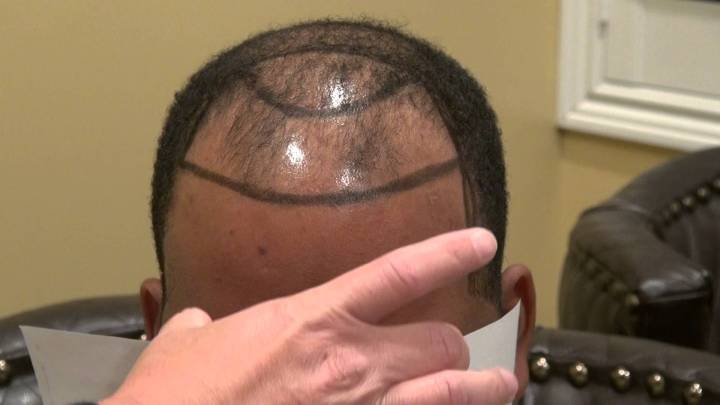
- Know your hair type. Knowing what type hair you have will allow you to choose the best products for keeping it healthy. You will also know what products to avoid when styling so that your bald spots don’t look too obvious.
- Ensure you are getting these vitamins: iron, Vitamins A, C and D. Healthline explores added vitamins you need.
- Avoid tight hairstyles, keeps those locs loose man!
- Avoid pulling on your hair, that goes for facial hair too!
- Avoid supplements which cause hair loss.
- Stop
smoking. - Use topical creams and oils such as Rogaine’s Hair Loss & Thinning Treatment, Jamaican Castor Oil or coconut oil. Balding Beards offers a list with more products you can check out.
- Keeps and Hims also have really effective treatments that you can check out.
- Layers and extensions are also now available on sites such as lanicsolutions.
- Surgery, plasma injections and supplements are also suggested by GQ for regrowth.
- See a dermatologist. Knowing the real cause of your hair loss will help you make the best treatment decisions.
Men have been dealing with hair loss since the beginning of time and science has offered ways to reverse the effects of genetics and age. So you can have the healthy head of hair that you want. Go get it!
See you in my next blog.
 Manes and Crowns
One thought on “Hair Loss in Men, Why?”